Automated swing gates in Teesside
Automated swing gates cost £3,200 to £7,500 fitted on Teesside. A pair of leaves on underground motors or ram arms suits most driveways with the depth to let them open, and it is usually the most cost effective way to get an automatic entrance.
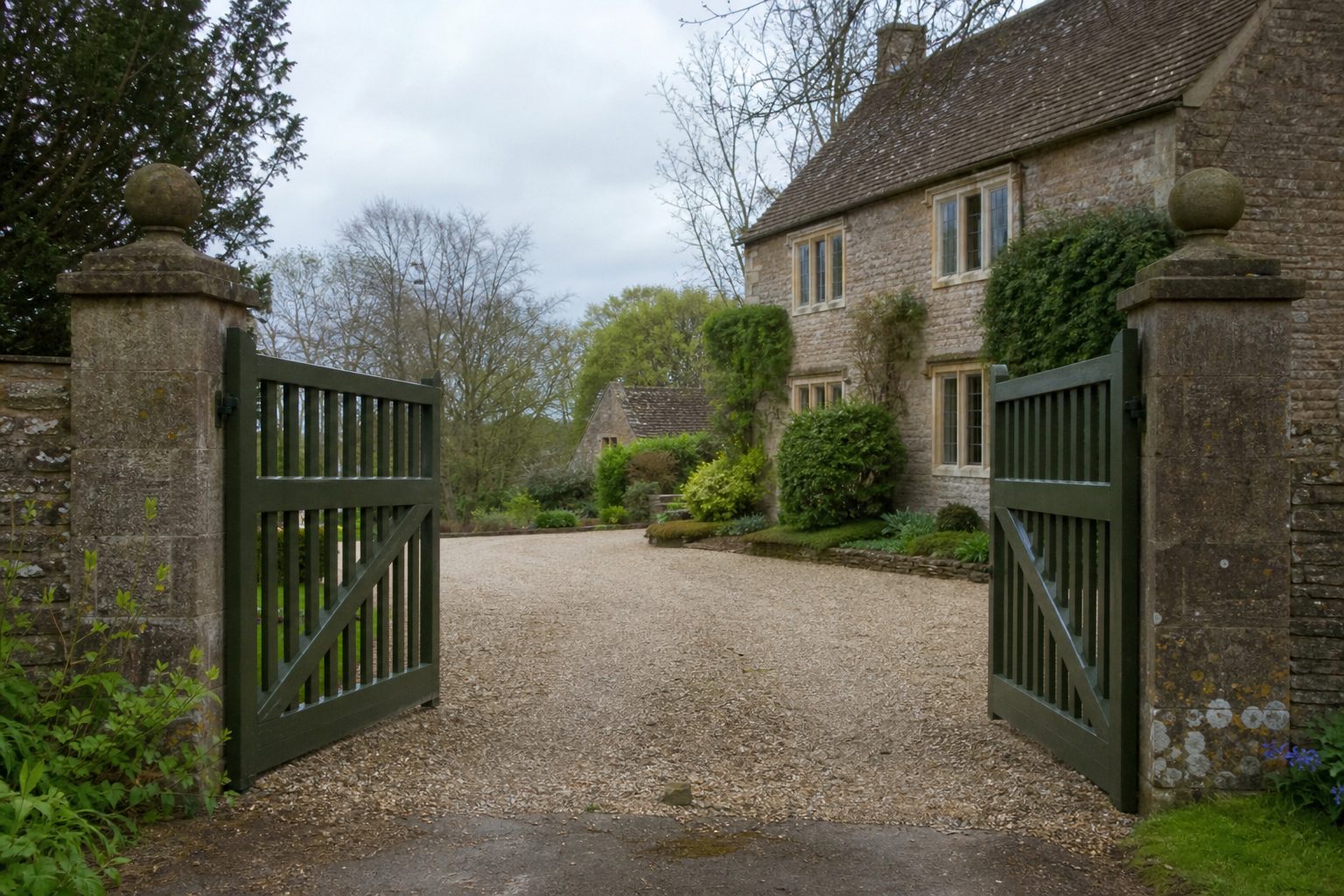
Why most Teesside driveways end up with swing gates
They are simpler, they cost less than an equivalent slider, and they look right in front of the house types that dominate here, from the bay-fronted semis of Linthorpe to the newer detached plots at Ingleby Barwick, Wynyard and Nunthorpe. A pair of leaves needs depth rather than width: room for each leaf to travel its arc without meeting a parked car, a rising drive or a bin store. Where that depth exists, swing gates are almost always the better value.
Underground motors or ram arms
Underground operators sit in a drained box directly under the hinge point, so once the driveway is made good there is almost nothing to see. They are the choice for stone pillars, period frontages and anyone who does not want hardware on show, and they need ground that drains, since a flooded box is a dead motor. Ram or articulated arms bolt between pier and leaf. They cost less, are far easier to service or replace, and cope better with pillars set back from the hinge line. On a windy plot, ram arms also hold a leaf more firmly against gusts.
Opening inwards, outwards or both
Gates next to a public highway should not swing out over the footpath, so inward opening is the default and often the only compliant option on a street frontage. Where the drive rises steeply through the arc, outward opening or rising hinges may be the only way to make a pair work, and that needs enough set-back from the road to be safe. On very steep entrances, this is the point where the survey recommends a sliding gate instead. Better to hear that before you have paid for gates that scrape.
Wind, weight and Teesside weather
A solid-board leaf two metres wide is a sail, and the wind coming up the Tees valley or in off the sea at Redcar tests it every winter. Slatted, vertical bar or louvred infills cut that load dramatically and take strain off the motors and hinges. Where privacy matters, a partial solid infill with a slatted upper section is a sensible compromise. Weight is the other constraint: hardwood looks magnificent and pushes the motor specification up, aluminium keeps things light, and steel sits in between with the most strength per section.
Safety on a swing pair
The hazards on swing gates are the crushing point where the leaf closes against the pier, the shear points at the hinges, and the arc itself where a child or pet can be caught. A compliant installation covers those with photocells across the opening and often a second set inside, hinge guards where the geometry needs them, force limitation measured on a gauge at the leading edge, and a manual release. Force settings drift as hinges wear, so a gate that shuts harder each year needs re-testing rather than tolerating.
Automatic closing and access
Most people set an auto-close timer of a few seconds to a couple of minutes, so the gates are never accidentally left open. Free-exit sensors or a ground loop open the gates automatically when you drive out, and a keypad, intercom or GSM unit deals with visitors. All of that is worth deciding before installation, because the cabling is trivial to include on the day and expensive to add later.
Areas We Cover
- Electric gates in Middlesbrough
- Electric gates in Stockton
- Electric gates in Billingham
- Electric gates in Redcar
- Electric gates in Saltburn
- Electric gates in Guisborough
- Electric gates in Hartlepool
- Electric gates in Yarm
- Electric gates in Eaglescliffe
- Electric gates in Ingleby Barwick
- Electric gates in Thornaby